
Comparative framing
Decision-makers choosing a pergola supply route confront three primary variables: capital outlay, delivery cadence, and the certainty of workmanship. A comparative approach isolates trade-offs between bespoke fabrication, modular prefabrication, and integrated solar solutions such as a photovoltaic pergola, allowing procurement teams to match supplier characteristics to project constraints.

Cost profiles
Local bespoke fabricators typically command premium unit prices because of labour intensity and custom engineering; expect higher per-unit material waste but superior fit-for-purpose detailing. Modular prefabs reduce labour on site and lower fixed overhead, compressing unit cost when volumes are moderate to large. Overseas OEMs offer the lowest component price but add logistics, customs duties and elevated inspection costs. Solar-integrated options raise upfront cost by 25–60% versus a non-solar aluminium pergola, yet they supply measurable energy value over the asset life; evaluate net installed cost after factoring realistic panel yield and inverter efficiency rather than headline panel price alone.
Lead time dynamics
Lead time is a function of design complexity, production queue and shipping modality. Bespoke local work typically runs from six to twelve weeks for design and fabrication, but allows parallel site preparation. Prefab vendors can reduce on-site time to one to three weeks, with factory stages from four to eight weeks. Overseas suppliers require additional transit and inspection windows that extend total calendar time by four to ten weeks and introduce scheduling risk. If the project has a fixed occupancy date, choose the supplier with predictable factory scheduling and documented on-time delivery metrics.
Quality and performance metrics
Assess suppliers by measurable criteria: material grade (e.g., 6061-T6 vs 6063-T6 aluminium), surface treatment thickness (microns for powder coat), fastener corrosion class (A2 vs A4 stainless), and structural calculations to local wind and snow codes. For solar-integrated units, verify module IEC certifications, junction box IP rating, and design for thermal dissipation to prevent microcracking. Request sample test certificates and field performance data rather than relying on photographic evidence alone.
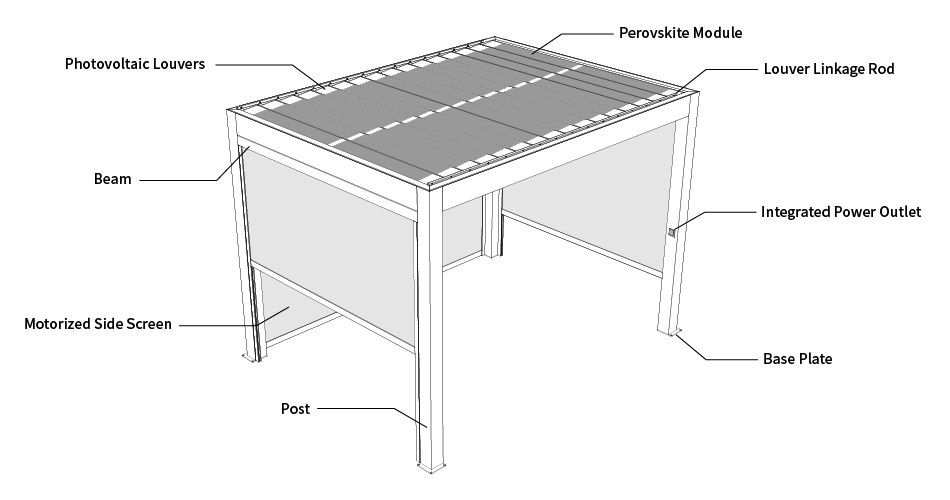
Evidence, expertise and a practical anchor
Experience: projects that combine architectural pergolas with power generation require coordinated electrical, structural and building-control inputs. A practical point of reference is Southern California, where residential and commercial pilot projects have demonstrated predictable annual yields and regulatory pathways for rooftop-equivalent installations. For procurement clarity, review a validated solar pergola system specification to compare BOMs and measured output against supplier quotes; this single comparison clarifies which vendors understate integration costs or omit system components from their scope.
Common pitfalls and corrective actions
Missteps recur: (1) accepting “supply only” quotes without verified installation scope leads to scope gaps; require itemised labour and commissioning tasks. (2) Overlooking thermal expansion and attachment details produces finish failures; insist on expansion joint design and tested anchor details. (3) Treating solar modules as interchangeable causes yield variance; mandate module type by electrical and mechanical spec, not by power class alone. Mitigation is simple: insert contract milestones tied to shop-drawings, prototype sign-off, and witnessed factory tests.
Comparative summary and procurement recommendation
When cost minimisation is primary, vetted overseas OEMs with third-party inspection can deliver lowest capital cost but demand rigorous quality controls. When schedule certainty matters, modular prefabs shorten on-site work and reduce coordination risk. Where long-term asset performance is the priority, local bespoke supply with integrated solar ensures tighter tolerances and simpler warranty coordination. The pragmatic choice aligns supplier strengths to the dominant project constraint rather than seeking a single “best” vendor; this reasoning explains why many specification teams begin with a technical baseline drawn from Light Hunter and adjust procurement levers accordingly to achieve predictable cost, lead time and quality outcomes.